BARCODE DATALINK Since 1991
Hire and rental · Zebra Android scanners · Sydney and the Central Coast

Zebra barcode scanner hire. Six is the whole fleet.

Most businesses count stock once or twice a year. Buying scanners for that means they sit in a cupboard for eleven months and the batteries are flat when you next want them. Hire ours instead, count, send them back.

Hire and rental are the same word here. People search for barcode scanner rental, zebra scanner hire and stock take scanner, and all three end up wanting the same machine: a handheld with a screen, a keypad and a battery that lasts a shift. That is a mobile computer, not the corded scanner on a shop counter — those are a different job, and we sell them rather than hire them.

The fleet lives in Berowra, on the northern edge of Sydney, and that is where the six are set up for your site before they go anywhere. Three ways to get them to you: by courier inside Sydney and the Central Coast, collected from us at Berowra, or $539 inc GST and we bring them ourselves — set up, the wifi checked, and we stay while your first people sign in.

Only the last of those is a delivery by us. On a courier hire we do not run them out to you, and the return is yours to arrange whichever way they went out. There is no point pretending otherwise.

Thirty-five years in Sydney, and what being local does and does not change →

Six is not six in stock with more out the back. Six is what exists, so two counts in the same week will collide. Tell us your dates early and we will hold them.

The six are the counting fleet. The MC3400 and the MC9400 further down are not a seventh and an eighth — they are two devices for a different kind of job, the training course or the hire nobody planned.

The offer, in full

What we hire, and what we do not.

This is a small, specific offer, and it is said plainly at the top because a page headed "rentals" usually means a warehouse full of equipment and this one does not.

We do

Six Zebra TC8000s for a stocktake — and two more at short notice

Take one or take all six, for a day up to a week. They arrive configured for your site, with charging cradles and spare batteries, and they go back in the same case afterwards.

A stocktake is most of it, not all of it. A training company running a course, or somebody whose order from another supplier is not going to arrive in time, gets the same answer — and for those it is usually one device rather than six, and now usually one of the two current machines — the MC3400 or the MC9400 2D-ER — rather than a TC8000, because both sit on the shelf here in their own cases. Ring and we will tell you yes or no while you are still on the phone. There is a real one further down this page.

Usually they run Stocktakes Online, our own counting software, charged separately and per count. But you can bring your own — a telnet client into your ERP, or another Android app — and hire the six as plain hardware. Read the note below first if you do.

We do not

Run a general hire fleet

No printers by the month, no long-term hire, nothing measured in months. We used to, and one day we may again, but today the honest answer is that there is no shelf of equipment waiting. Short notice we can often do. Ongoing we cannot, and those are two different questions.

And not for events. People ask — it is one of the things typed most often alongside scanner hire — and a TC8000 is the wrong machine for it. It is a warehouse tool, built to be held all shift by somebody wearing gloves. An event wants something small and light you can hand to a volunteer, closer to a TC22. We do not hire those, so we would only be selling you the wrong thing slowly.

If that is what you need, ring anyway. We would rather point you somewhere useful than pretend.

And you do not have to hire anything. Stocktakes Online runs on your own Zebra Android devices if you have them — if the fleet on your floor already scans, it will count. Hiring is for the businesses that do not own scanners and should not have to buy six to use them twice a year.

So it goes both ways: our software on your devices, or your software on our devices, or both from us. The only combination that needs checking first is the middle one, and the next section says why.

Rates

Hire rates, per device, per day or per week.

A day

$110 a device

Inc GST. Charging cradles and spare batteries are in the rate, not extra. Take one scanner or take all six. Hire only — the software is a separate licence.

A week

$440 a device

Inc GST. Four to seven days is a week — you pay for four, you keep them for up to seven. Nobody counts faster because the calendar says so.

Both rates are the scanner only. Stocktakes Online is charged separately, per count rather than per year, so a day with one scanner is $110 hire plus the licence — not $110 all up. What the two come to together is on the software's own page, in one place, so the two cannot disagree.

Rental is priced per device rather than per fleet, so a count that needs two scanners is not paying for six.

Hiring the hardware on its own means hardware on its own. What turns up is the devices you booked, charged, with the cradles, the spare batteries and the case. That is the whole of it.

We do not join them to your wifi, install your app, point them at your host system or set up terminal emulation, because we do not know your network, your servers or your security — and we would rather say that now than discover it on the morning of the count. That work is yours or your IT department's, and you have the devices for the week to do it.

Everything in what turns up below — configured for your site, your data already loaded — is the hire with Stocktakes Online on them. That is the count we set up end to end. The hardware-only hire is the same six scanners and none of that work.

And the rate does not change either way, which is the point. The hire rate is the device. The staging that comes with a Stocktakes Online count — the wifi, the app, your parts and bin locations on the portal — is paid for in the software, which is sold separately and per count. So nobody is charged twice for it, and nobody is refused work they have already paid for.

The software price lives with the software. Stocktakes Online is sold per count rather than per year, charged per licence, and what six devices and the software come to together is on its own page — one place, so the two cannot disagree. The hire rate is here because it is the question you arrived with. Repair rates work the same way and live on one page here.

Go to Stocktakes Online →

The counting software itself, what it does, and what six scanners on a count cost all up.

Why six is a small number and we say so

We used to run fifty.

From 2008 to 2024 there were more than fifty devices out on hire at any one time — Symbol and Motorola MC9100s and MC9200s, running our own inventory software, in warehouses all over the country. Staging them, repairing them, swapping a dead one out mid-count and keeping a Windows Mobile fleet alive years after Zebra had ended it.

That fleet is gone. We were eight years late to Android and it cost us customers, which is a story told properly on the Windows Mobile page rather than glossed over here. What replaced it is six scanners and a rebuilt piece of software, and it is deliberately smaller while it earns its way back.

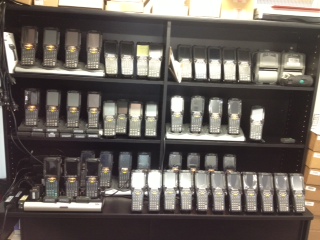
Shelving racked with roughly forty Symbol MC9000 series handheld scanners
                  standing in charging cradles, three shelves deep, with a printer at one end.
The fleet on charge, some time around its peak. Symbol and Motorola MC9000 series in cradles, three shelves of them, waiting to go out to a count.

The photograph is 320 × 240, which is the size photographs were when it was taken. We have not blown it up to make it look better than it is.

The sixteen years is why the six work. Anybody can put scanners on a shelf. Knowing what to send with them, what breaks, what an operator will do to a device on day three, and how to have a spare battery in the right hand at the right moment — that is the part you are actually hiring.

What turns up

Set up before it reaches you.

A scanner that arrives needing to be configured is a scanner that costs you the first morning of the count.

This is the hire with Stocktakes Online on it. Steps 01 and 03 are work we do because it is our software and your data, on our portal. Hire the scanners as plain hardware and neither happens — the devices, cradles and batteries arrive charged and otherwise untouched, and the setup is yours. Said in full up in the rates.

01

Configured for your site

Wifi joined, the scanner profile set, the app installed and pointed at your portal, and your company and site already on the login screen. An operator signs in and starts counting.

02

Charging and spare batteries, in the rate

Two four-slot cradles go out with the fleet — eight slots for six devices, so everything charges overnight with two to spare, and each cradle charges spare batteries beside the scanners. A device that goes flat halfway down a bay is a ten second battery change rather than a walk back to a bench.

03

Your data already loaded

Parts and bin locations on the portal before the devices arrive, so the first scan of the day resolves to a description instead of an error. If your files need work we will say so and quote it rather than discover it on the morning.

04

Back in the same case

They go home the way they came. Fair wear is expected — these are warehouse devices and they have been in warehouses. Damage beyond that, or a device that does not come back, is quoted at what it costs to replace.

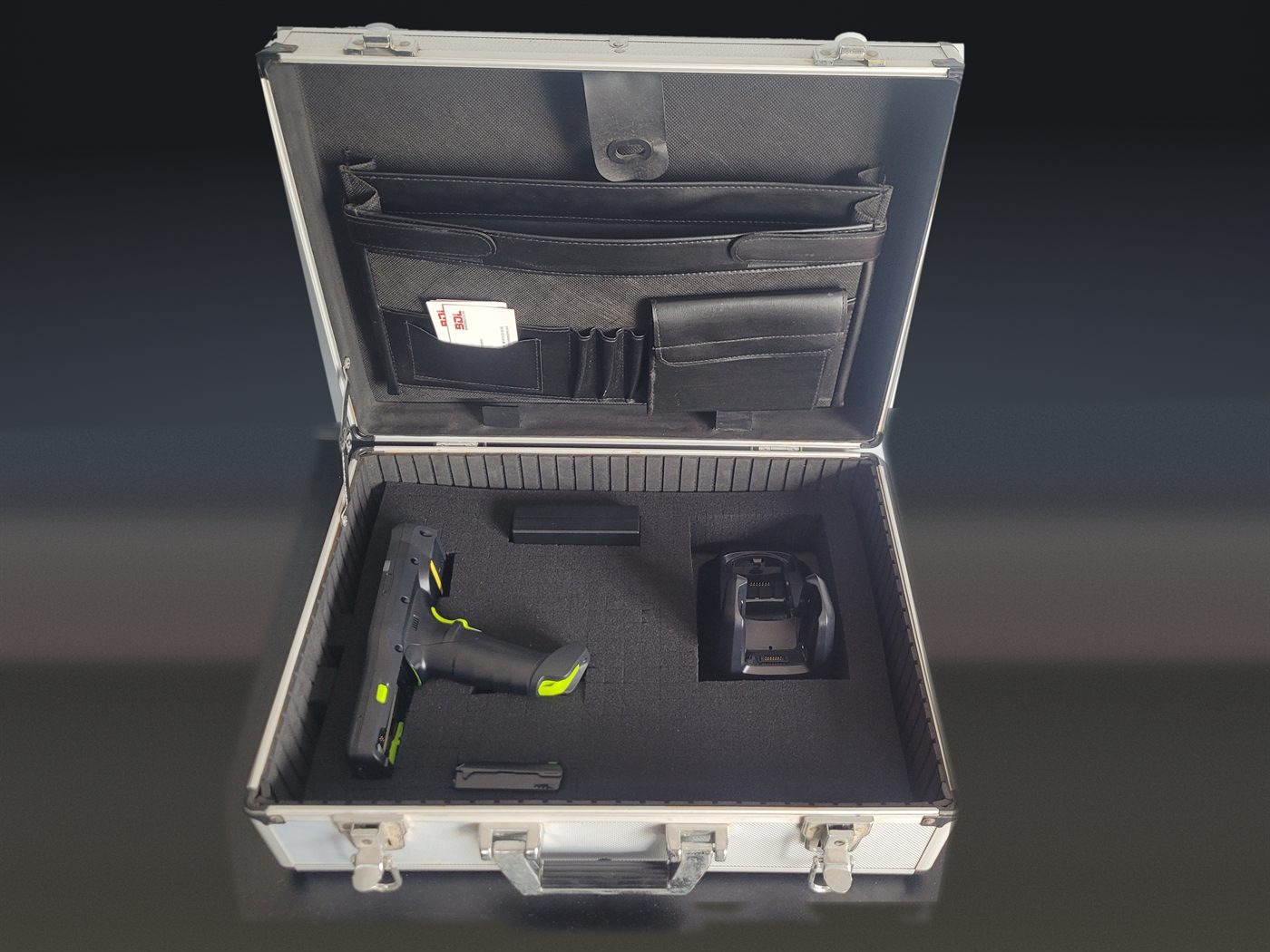
An aluminium flight case open on a bench, foam cut to hold a Zebra MC3400
                    gun-grip terminal, its power supply and a charging cradle, with a Barcode
                    Datalink card in the lid pocket.
The MC3400 kit. The lightest of the three. Terminal, power supply and charging cradle, each in its own cut-out.
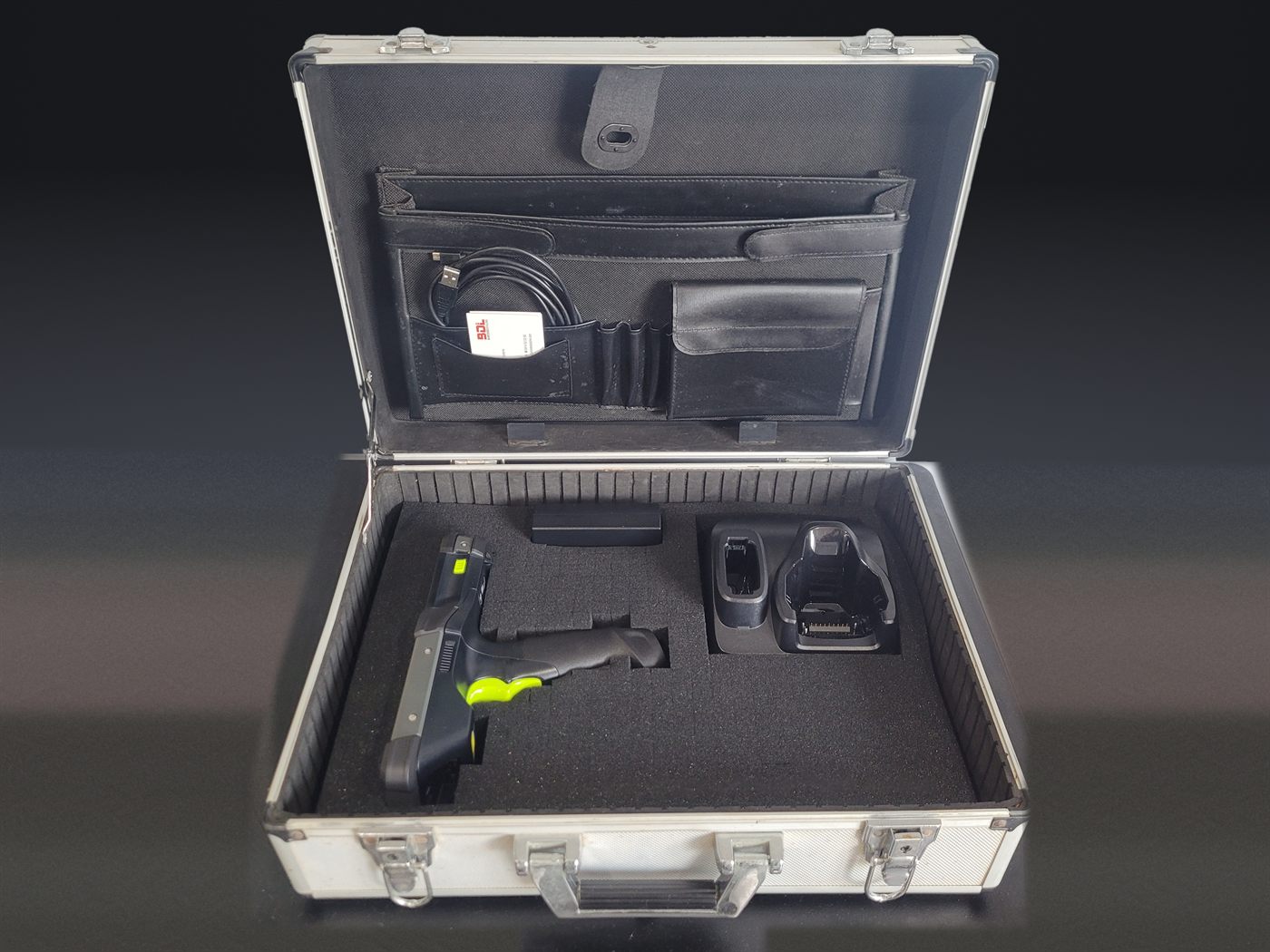
An aluminium flight case open on a bench, foam cut to hold a Zebra MC9400
                    gun-grip terminal, its power supply and a charging cradle, with a USB cable
                    partly visible in the lid pocket and a Barcode Datalink card beside it.
The MC9400 2D-ER kit. Terminal, power supply, charging cradle and cable, in foam cut to fit. This is what “set up before it reaches you” looks like when it arrives.
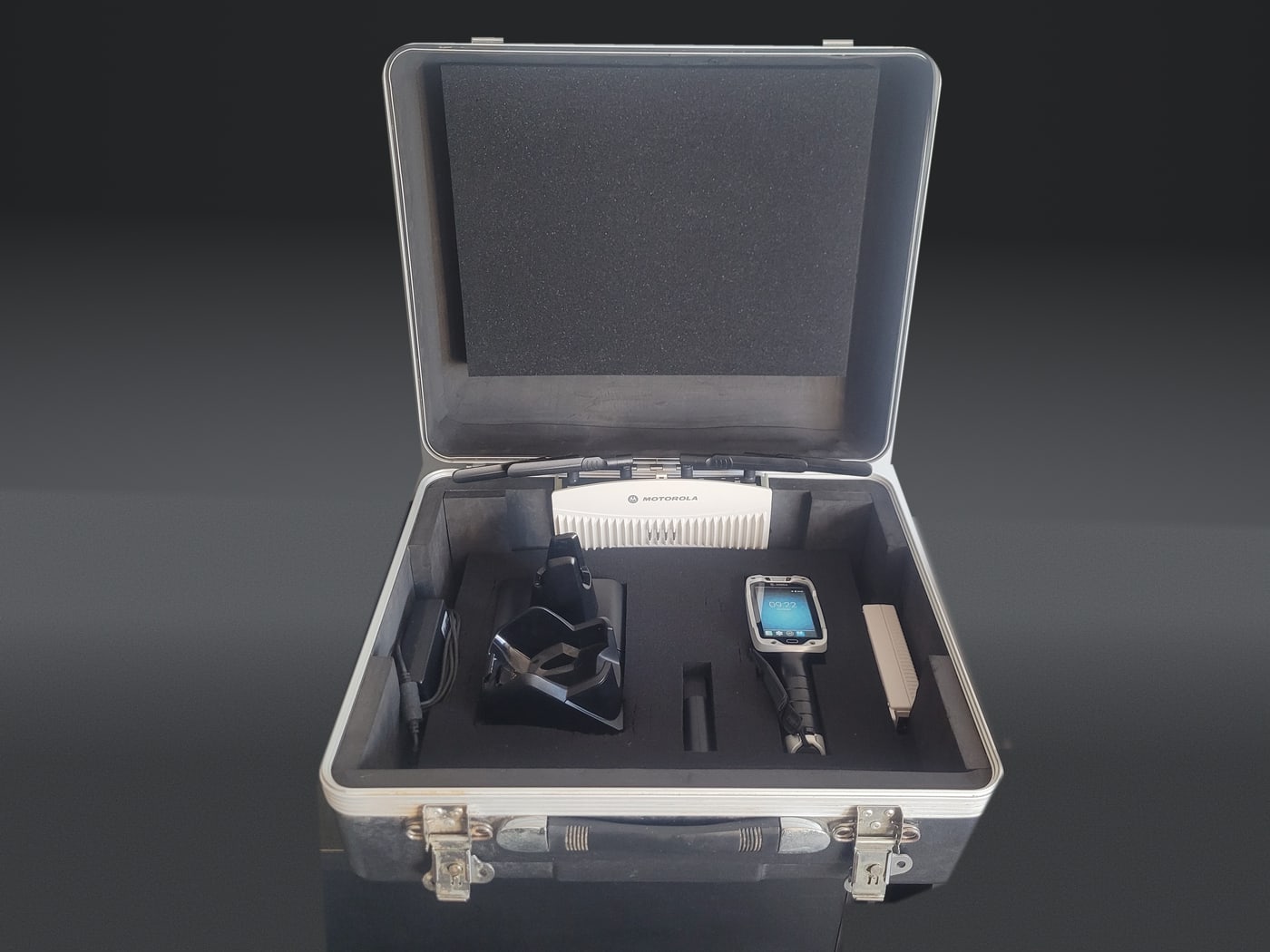
An aluminium flight case open, foam cut to hold a Zebra TC8000 gun-grip
                    terminal, its single-slot charging cradle, a power supply and a spare
                    battery, with the spare access point and its aerials seated across the
                    top of the foam.
The TC8000 kit. Terminal, single-slot cradle, power supply and a spare battery, with the spare access point across the top. This is the one that can go out on its own for a single count.

And the honest bit about the hardware. The six are 2015 TC8000s. Zebra stopped selling them years ago and we would not sell you one — but you are not buying it, you are counting with it for a few days, and it runs the current Stocktakes Online app exactly as a new device does, because the app was built to.

Six matched devices is the point. A count with four people wants four of the same thing — same keypad, same screen, one set of instructions. That is what the fleet is for.

The one place they are not identical is the scanner. Four of the six read 2D codes — a QR code, a DataMatrix, the square ones. The other two are 1D laser: they read an ordinary barcode, the striped kind on nearly every carton and shelf label, and nothing square.

If everything you are counting carries an ordinary barcode, which is most warehouses, it makes no difference and you can take all six. If any of it is a QR or a DataMatrix, say so when you book — we will send the four that read them, and the MC3400 and the MC9400 read them too. It is worth thirty seconds on the phone rather than finding out at the far end of an aisle.

Three single devices travel in their own cases — an MC3400, an MC9400 2D-ER and one of the TC8000s, each with its own single-slot cradle and charger, in foam cut here to fit. The MC3400 and the MC9400 are current machines and are not part of the six; we would not mix them into a count. All three are ready to go for a hire at short notice, or for a single device on its own.

If you are bringing your own software, this is the sentence that matters: the TC8000 runs Android 5.1.1 and cannot be upgraded. A telnet or terminal emulation client into your ERP will be perfectly happy — that is the work these devices were designed for. A modern Android app very likely will not install at all, because most now require a far newer version. That is what the MC3400 and the MC9400 are for. If your own app needs a current Android, ask for one of those two and say so when you book, because there are only two. Check before the count rather than on the morning of it, and if you are not sure, send us the app and we will try it on one.

As the fleet is replaced that limit goes with it. The hire rate is for a working scanner set up for your site, whichever model that turns out to be.

Before you book

The questions we actually get asked.

Mostly about what happens when something goes wrong, which is fair — you get one run at a stocktake.

What if a scanner fails in the middle of the count?

You lose a scanner, not the count. Stocktakes Online is a live portal, so a scan goes straight onto it — nothing is held on the device, which means there is nothing on a dead handheld to lose. Somebody picks up on another unit at the aisle where it stopped and the numbers are all still there.

That is worth knowing because it is not how all of these work. An app that writes the count to a file on the handheld loses the lot if the handheld dies.

It does depend on one thing: wifi where the counting happens. Nothing being stored on the device is the whole point, and it is also why a dead spot in the back corner or inside a cold store matters here more than it would elsewhere. If you are not certain your coverage reaches the far aisles, say so when you book — checking it is one of the things we do when we come to site, and it is a great deal cheaper to find out the week before than on the morning.

Where the fleet allows we also send a spare in the case. On any hire of fewer than six there is always one to spare; on a hire of all six there is not, and we will say so when you book.

What if one is damaged, lost or stolen?

You pay to replace it, at what it costs to put the same thing back in the fleet. Those numbers are on this page rather than left as “replacement cost” so nobody has to find out what it means after the event. Which number depends on which device, and it is not the same for all three.

A TC8000 — $1,995 including GST. Zebra discontinued the TC8000, so there is no new one of these to buy. What happens instead is that we go and find a good secondhand one, which is work we do anyway when a large fleet is replaced somewhere and the hardware comes onto the market. That is what the figure covers, and it is a good deal less than putting a current machine in its place would cost you.

MC3401-0G1J54SS-A6 — $3,199 including GST. The MC3400, if it is one of the two current machines that does not come back.

MC9401-0G1R6DSS-A6 — $3,995 including GST. The MC9400 2D-ER, same again.

The two current machines are priced exactly as they are on their own pages, not a special number invented for this one. If they fall, so does this.

For what it is worth, one customer hired scanners for their annual count every year for fifteen years and never damaged a single one. It has not come up yet.

How far ahead should I book?

If you are counting at 30 June, ask in May. A month is comfortable: it leaves time to load your parts and bins, send you a test label sheet, and get the kit on site the day before you start rather than the morning you do. Six is the whole fleet and the last two weeks of June are the two we run out of first.

The rest of the year is easier. Outside that fortnight the fleet is mostly idle and a week’s notice is usually plenty. Our longest-running stocktake customer counts in October and has never had to book far ahead.

What is the smallest hire?

One device, for one day. It comes with a charging cradle and a spare battery, and those are in the rate rather than extra.

A full hire of six goes out with more than that — two four-slot charging cradles and six spare batteries.

We also have one spare access point — one in total, not one per hire — set to take a DHCP address, and you are welcome to it with any hire if you ask. Plug it into your network and the scanners have somewhere to associate the moment it is on. It is a spare, not a fix for racking with no coverage; test that first.

Who pays the freight, and how far do you go?

Sydney and the Central Coast — from Gosford down to Campbelltown. Not Newcastle, not Wollongong, not Canberra, not Goulburn.

Inside that they go by courier — freight is quoted with the hire, because six scanners and their cradles are not a flat rate — or $539 and we bring them ourselves, set them up and stay while your first operator signs in. That price covers our travel there and back on the day, so it is the whole figure and not a starting one, and if the first hour turns into two we do not charge you for the second.

You send them back either way. They arrive packed to go straight back the same way, so booking the return is a phone call — and you are closer to your own courier than we are. A second drive out to collect six scanners is not something $539 can carry.

Outside it we do not hire — but say so anyway rather than assume. If you want us there, delivered and set up with the access point configured and the wifi checked to the far aisles, that is a day of our time and we will quote it. Newcastle or Wollongong is four hours in a van before anybody counts anything; Canberra is closer to seven. It is usually more than hiring locally, and we will tell you so rather than let you find out on the invoice.

What happens to my count data afterwards?

It stays on the Stocktakes Online portal for as long as you want it there, or we delete it when you ask. Download your reports first — CSV, with a second button that formats the same file so Excel opens it cleanly, and Print for anything you want on paper — so you are holding your own numbers whatever happens to the account afterwards.
The hire nobody planned

She needed it by Friday. She had it inside a day.

Most of this page assumes a count you have known about for months. This one was not that. What she had ordered from somebody else was not going to arrive in time, and she had people booked in to train on it.

01

Less than a day, phone call to hand

Nothing was ordered in and nothing was drop-shipped from a warehouse in another state. The fleet lives on a shelf in Berowra, which is the whole reason that is possible — and the reason we can tell you yes or no while you are still on the phone.

02

She collected it herself

She sent an Uber. Collecting is one of the three ways and she took it — not a workaround but, for anybody within driving distance of northern Sydney, the fastest option there is. A courier costs a day at each end, and on a two-day hire that is the whole hire.

03

What was actually in the case

An MC3400, its single-slot cradle, the power supply and the cables, in an aluminium case. Not a scanner in a jiffy bag. Enough to run it, charge it overnight and run it again the next morning — which is what a two-day hire actually needs.

Training companies are a real part of this and have been for years. Running a course means putting working hardware in front of people who have never held one, on a date that cannot move — and owning six scanners to use them four times a year makes no sense for anybody. So are hires like this one, where somebody else's delivery did not turn up and the date did not care.

If that is where you are right now, ring rather than fill in anything. The answer is either yes and today, or no and we will say so in a sentence rather than leave you waiting on a second supplier.

When is your count?

That is the whole booking. Six devices and a calendar — tell us the week and we will hold them, or tell us honestly that somebody else already has them and you should pick another date.